Author: DRG Rekenmeesters

  • 6 Festive Season Survival Tips for Your Business

    6 Festive Season Survival Tips for Your Business

    “At Christmas play and make good cheer, for Christmas comes but once a year.” (Thomas Tusser, English poet)

    Despite the slew of public holidays, increased cyber threats, stretched staff and supplier shutdowns, it’s still possible to set your business up for a smooth festive season.

    A few focused actions taken today can make all the difference! Here are six things you can do now to set your business up for a successful end to the year.

    1. Lock down your cyber defences and back up everything

    Cyberattacks targeting payment systems, email accounts and customer data spike during the festive period, and the consequences of a breach can be severe.

    Back up your essential data right now, test that the backup actually works, and keep one copy in the cloud and another offline on a securely stored external drive.

    Make sure multi-factor authentication is active on all email, banking and financial systems; deploy any outstanding security patches before the holidays; and remind your team not to click on the most common entry points for festive-season fraud, namely suspicious links, fake delivery notifications and unexpected invoices.

    2. Map the dates that matter

    Map out how public holidays and annual shutdown periods affect your staffing, your delivery commitments and your customer service levels. This year you’re looking at Wednesday 16 December, Friday 25 December, Saturday 26 December and Friday 1 January 2027.

    Many manufacturers, construction firms, packaging plants and distribution lines close their order books as early as 15 December. Check in with your key suppliers today to confirm their last delivery dates and any extended lead times.

    Send out all December invoices as early as possible and follow up on outstanding invoices with statements well before the traditional shutdown dates.

    3. Communicate availability clearly

    Ensure everyone on your team knows who is responsible for what; who is the emergency contact and when; and how to handle urgent decisions while management is away.

    Make it easy for clients to find out when your business is open and to reach someone in an emergency. Send festive season wishes early, and set up automated email responders and WhatsApp Business templates that clearly state when your business is closed and who to contact for urgent matters. Update your Google Business Profile, your website and your social media pages with your exact holiday trading hours and contact details.

    Call your major clients to confirm whether they will need support over the break. Also check in with your own suppliers and service providers.

    4. Check in with your team, especially those not taking leave

    Take a moment to assess whether your team is stretched too thin. If workloads are unreasonable, adjust deadlines or bring in temporary help. Burnout in December only leads to absenteeism in January.

    Of course, December is not a holiday for all employees, and the staff who keep things going during this period deserve recognition and support. Even small gestures of appreciation go a long way: flexible hours or shift rotations to help them juggle personal commitments, a special meal or treat during their shifts, or an extra day of paid time off later in the year.

    5. Ensure those on leave actually take a holiday

    Insist that those employees who are taking their annual leave switch off and truly disconnect from work. Taking a proper break is not a luxury. The employees who come back to work most refreshed in January are those who genuinely stopped thinking about work, not the ones who checked emails every evening.

    In this regard, structure works better than willpower. Remove work email from personal phones and set up a clear out-of-office message with an emergency contact. If there is a specific problem an employee is worried about, delegate it to someone or agree and document how it will be dealt with in January.

    6. Speak to our team

    If you would like assistance with any of these year-end preparations, or to identify opportunities or risks you may have overlooked, we invite you to have a quick conversation with our accounting and tax team before the holidays get into full swing.

    Every business is different, and the right approach to facing festive season business challenges depends on your specific circumstances. We can provide advice on practical steps you can take right now to protect your operations, your team and your peace of mind over the festive season.

    Disclaimer: The information provided herein should not be used or relied on as professional advice. No liability can be accepted for any errors or omissions nor for any loss or damage arising from reliance upon any information herein. Always contact us for specific and detailed advice.

    © AccountingDotNews

  • Gifts, Bonuses and Benefits: The Taxman Wants Some Too

    Gifts, Bonuses and Benefits: The Taxman Wants Some Too

    “People work for money but go the extra mile for recognition, praise and rewards.” (Dale Carnegie)

    The festive season naturally prompts employers to recognise a year of hard work. Whether it’s a year-end bonus, a gift voucher or a celebratory function, the intention is to show appreciation and boost morale.

    Yet, the tax treatment of these gestures is rarely straightforward, and what is intended as a reward can feel like a letdown once SARS has taken its share.

    The key to success is to check in with us before committing to any gifting or bonus structure. A little planning upfront ensures your team receives maximum value and your business stays compliant.

    A bonus that shrinks…

    Cash bonuses, including the popular 13th cheque, are the most direct way to reward staff. These, however, are not simply taxed at a flat rate. Instead, bonuses are aggregated with your other remuneration and taxed based on the applicable annual tax tables. This means that the amount of the bonus will be added to an employee’s annual salary to determine the rate of tax payable for the year.

    The bonus amount might push some employees into a higher tax bracket, significantly eroding how much of the bonus the employee actually receives.

    Gift vouchers and physical presents

    Even swapping cash for a retail voucher or a physical gift will not exempt an employee’s bonus or gift from tax. Under the Income Tax Act, any asset provided to an employee free of charge or below market value is a taxable fringe benefit. Gift cards, hampers, electronics and watches all count.

    The taxable value generally depends on its market value or, in certain circumstances, the cost to the employer, less any amount paid by the employee. Employers must declare these taxable fringe benefits on the employee’s IRP5. There is no minimum threshold that makes small gifts tax-free, so a R500 voucher must be reported the same as a R5,000 one.

    Certain benefits may qualify for exemptions or a nil taxable value under the Income Tax Act. However, these concessions depend on the nature and purpose of the benefit and the applicable statutory requirements. When in doubt, get advice for your specific circumstances. One notable and welcome exception is a long-service award for 15 years (and any subsequent unbroken period of 10 years’ service) with the same employer. In this case the first R16,000 (cash or other awards) is exempt from tax.

    Accommodation and travel

    Some employers reward staff with holiday accommodation or travel tickets rather than cash. These too are taxable fringe benefits. The value of holiday accommodation generally depends on whether the employer rents the property from an independent third party or provides accommodation it owns. Either way, the employee is taxed on the benefit received.

    Flights, bus tickets and other transport arranged by the employer are also taxable fringe benefits. Even gifts given to an employee’s spouse or children are treated as if the employee received them directly, with the same reporting obligations.

    Alternative ways to reward

    Several alternatives can deliver real value to employees, while avoiding the worst of the tax bite.

    • For cash rewards like a 13th cheque, tax smoothing can soften the tax blow. Instead of deducting all the PAYE in December, which can come as a shock to the employee, the employer spreads the estimated tax burden across the full year, so the bonus feels like the reward it was meant to be.
    • An occasional office party or a team meal are great opportunities to recognise, appreciate and treat team members. As Dale Carnegie says: “People work for money but go the extra mile for recognition, praise and rewards.” The same goes for a once-off team-building outing or a year-end function, which may qualify as deductible business expenses for income tax purposes.
    • Paid time off is another option which generally doesn’t result in additional tax implications for the employee. An extra day or two of leave can feel as valuable as a modest cash bonus.
    • Employers can facilitate charitable giving through payroll deductions. Employees who donate part of their remuneration to a section 18A-approved organisation may qualify for a tax deduction, subject to the applicable limits and documentation requirements. Employers that wish to fund donations themselves should obtain advice on the appropriate tax treatment.

    The right approach depends on your business, your staff and the reward you have in mind. A bonus structure that works for one business or team may not suit another. And even a gift that seems small may carry reporting obligations you did not expect.

    A quick conversation with our team can prevent tax surprises for everyone and ensure bonuses and gifts are structured in a tax-efficient manner. It’s all about making sure your generosity works as hard for everyone as you intended.

    Disclaimer: The information provided herein should not be used or relied on as professional advice. No liability can be accepted for any errors or omissions nor for any loss or damage arising from reliance upon any information herein. Always contact us for specific and detailed advice.

    © AccountingDotNews

  • Free up Resources. Expand Your Business

    Free up Resources. Expand Your Business

    “The most menacing competitor is not the other fellow in the same line of business, but waste.” (Royal Bank of Canada, Monthly Letter, September 1967)

    The festive season is a great time to take stock – and to look ahead. For a small business owner, resources extend well beyond the money in the bank. They include employees’ time and skills, physical equipment, customer relationships and the capacity to deliver more work. When these resources aren’t being used effectively, opportunities for growth can easily be missed.

    Before seeking additional finance or committing to expensive expansion plans, examine how the existing business operates. Are employees spending hours on tasks that could be automated? Is money tied up in slow-moving stock? Are customers taking too long to pay? Addressing these issues can release resources that can be redirected towards growth without necessarily increasing operating costs.

    Review your business expenditure

    Start by examining where your money goes each month. Rather than simply cutting costs, identify which expenses contribute directly to generating revenue and which have become habits.

    Review software subscriptions, insurance, professional fees, utilities, advertising and supplier contracts. Are you paying for services you no longer use? Could you negotiate better rates or find alternatives offering the same value?

    Small savings can accumulate quickly. Eliminating ten unnecessary expenses of R500 a month releases R60,000 over a year. That money could be redirected towards marketing, equipment or additional staff.

    Improve your cash flow

    A profitable business can still struggle to expand if too much money is tied up in unpaid invoices. Improving collections is one of the simplest ways to release cash tied up in outstanding customer accounts.

    Invoice customers promptly, establish clear payment terms and follow up on overdue accounts. For larger projects, consider requesting deposits or arranging staged payments rather than carrying the entire cost until completion.

    It’s also worth negotiating better payment terms with suppliers. If customers take 30 days to pay but suppliers expect payment within seven days, the business must finance the difference. Aligning these arrangements can be a game-changer.

    Concentrate on your most profitable activities

    Not all revenue is equally valuable. Some customers generate healthy margins with relatively little admin, while others demand considerable time and additional services for comparatively little return.

    The same applies to products and services. A popular product might generate impressive turnover but deliver limited profit once materials, labour and distribution costs are deducted.

    This is why you have to regularly review profitability across your customer base and product range. Consider adjusting prices, changing delivery arrangements or reducing the time spent on less profitable activities. It’s all about directing more resources towards the parts of the business that produce the best financial returns.

    Make better use of your employees

    Hiring additional staff might seem like the obvious response to increased demand, but first consider whether existing employees are being used effectively. Look for duplicated responsibilities, unnecessary meetings and administrative tasks that distract people from their primary roles. Cross-training employees can also give your business greater flexibility when workloads fluctuate or new opportunities arise.

    Automate repetitive tasks

    Administrative work can consume hours that would be better spent developing the business. Invoicing, payroll, appointment scheduling, customer enquiries and report preparation are all potential candidates for automation.

    Accounting platforms can automate invoices and payment reminders, while customer relationship management software can organise sales enquiries and track prospective customers. AI might even have a role to play – but proceed with caution there.

    Start with the tasks that consume the most time. Compare the cost of introducing new software with the hours it will free up for employees to do other work.

    Consider outsourcing

    If tech isn’t the answer, then it’s possible that outsourcing may be. Employing a full-time specialist is not always financially sensible, particularly when the workload does not justify a permanent position. Bookkeeping, payroll, website maintenance, graphic design and IT support are all functions that could potentially be outsourced.

    Compare the cost of an external provider with the full cost of performing the work internally, including salaries, equipment and management time.

    Release money tied up in stock and equipment

    For businesses that carry inventory, unsold stock can absorb money that could be put to better use. Regular stocktaking can identify slow-moving products, obsolete materials and over-ordering.

    Consider smaller, more frequent purchases or negotiating better delivery arrangements with suppliers. Where appropriate, promotional pricing can help clear older stock, although discounts need to be weighed against lost margins.

    Equipment also deserves attention. Machinery, vehicles and office space that are rarely used represent capital that could potentially be released. Selling surplus assets, sharing facilities or hiring equipment when required can reduce unnecessary expenditure.

    Reinvest resources where they will generate growth

    Freeing up resources is only half the exercise. The other half is ensuring that the money, time and capacity released are directed towards activities that can grow the business.

    That’s why it’s vital to identify your expansion priorities. Perhaps you need additional marketing to reach new customers, a salesperson to increase revenue or equipment to fulfil larger orders. Set a budget for each objective and measure the results.

    Review, review, review

    Using your resources as efficiently as possible is an ongoing challenge. What works for your business now may not be relevant in six months’ time. Want help crunching the numbers? Speak to us.

    Disclaimer: The information provided herein should not be used or relied on as professional advice. No liability can be accepted for any errors or omissions nor for any loss or damage arising from reliance upon any information herein. Always contact us for specific and detailed advice.

    © AccountingDotNews

  • 4 Reasons You Need to Upgrade Your Tech

    4 Reasons You Need to Upgrade Your Tech

    “More than 90% of people who took the survey would consider going elsewhere if they perceived the small business is using old and outdated tech.” (Russ Madlener, Microsoft)

    According to the Gartner Group, “the sticker price of a PC is less than 20% of what the machine costs your business over its life”. The other 80%, they say, accumulates silently in lost hours, repairs, energy, downtime and risk. And yet, studies show corporate machines are getting older, not newer. At the end of 2025, Microsoft reported that Windows 10 was still running on a vast share of business computers, despite no longer receiving routine security updates. So, what does this all cost your business? How is it impacting you? And how can you do something about it?

    The cheapest part of a computer is the computer

    Computers are like golden retrievers: the purchase price represents a fraction of the overall cost. This is because the cost of maintenance and replacing failing parts increases over time, and the software that was once supported free is phased out in favour of a newer version. When maintenance costs are added up over time, they may be more costly than simply replacing the machine.

    Slow machines tax you by the minute

    Productivity loss is the largest hidden cost and the easiest to ignore, because it never appears on an invoice. Techaisle has shown that a PC four years or older burns 112 hours of productive time annually. That’s nearly three working weeks per employee, spent waiting on load screens and rebooting after crashes, etc.

    The hidden security cost

    There is a threat that may be even greater than either of these: security. Check Point Software Technologies reports that around eight in ten South African small and medium businesses were hit by a cyberattack in the past year, and that organisations here collectively absorb more than two thousand attempted attacks every week.

    Old, unsupported systems are the easiest way for hackers to disrupt services, steal vital information or commit fraud. Windows 10 has not received a single free update since October 2025 and yet it’s still commonly used on South Africa’s work PCs. Paying Microsoft’s rising toll for Extended Security Updates (about R1000 per PC in year one, doubling every year) is clearly the wrong option!

    Old kit drives away your best people and your customers

    Your technology is also a hiring and retention weapon, whether you wield it or not. Unisys found that employees with outdated technology were 450% more likely to want to quit than those at technology-leading firms. Given the cost of replacing a worker, one avoidable resignation can fund several laptops.

    Customers also seem to be keeping a scorecard. In one Microsoft survey, 62% of consumers said they were more likely to become repeat customers of a business using modern technology, and around 60% considered a small business outdated if its computers were five to ten years old.

    The upgrade is the growth investment

    This is why the smartest owners treat upgrading their tech as compounding growth capital, not defensive spending. Deloitte’s Connected Small Businesses study of 2,013 American firms with fewer than 250 employees found the most digitally advanced earned twice as much revenue per employee, posted nearly four times the revenue growth, and were three times as likely to have created jobs in the previous year compared with the least digitally engaged. You don’t need to do it all at once, but you do have to start somewhere.

    • Check the refurbished market first: properly reconditioned business-class laptops cost a fraction of new and outlast most budget machines.
    • In some instances, it may be wiser to lease rather than buy. This way the cost stays monthly and predictable, and the risk of maintenance or a dead machine is someone else’s problem.
    • Talk to us about possible tax relief. SARS generally accepts a three-year write-off period for personal computers, including laptops. Qualifying small business corporations can opt for an accelerated write-off under section 12E, deducting 50% of the cost in the year the computer is first brought into use. A laptop bought in time is partly a laptop SARS helps pay for.

    The data, year after year, says the most expensive upgrade is always the one you keep postponing.

    Disclaimer: The information provided herein should not be used or relied on as professional advice. No liability can be accepted for any errors or omissions nor for any loss or damage arising from reliance upon any information herein. Always contact us for specific and detailed advice.

    © AccountingDotNews

  • The Profit First Business Model: Could it Work for You?

    The Profit First Business Model: Could it Work for You?

    “When less money is available to run your business, you will find ways to get the same or better results with less. By taking your profit first, you will be forced to think smarter and innovate more.” (Mike Michalowicz)

    Ask most small business owners how they manage money, and you’ll hear a version of the same formula: Sales minus Expenses equals Profit. It seems logical, but it also means profit is whatever happens to be left over, which is often nothing at all. This is the trap author and entrepreneur Mike Michalowicz set out to fix when he developed the Profit First system.

    Rather than treating profit as a leftover, Profit First insists it be allocated immediately, before covering a single expense. The remaining money becomes the operating budget, forcing owners to run leaner, smarter businesses. It sounds backward, even risky. But for thousands of entrepreneurs who have adopted the method, it has proven to be less about restricting growth and more about revealing which expenses were never necessary in the first place.

    Flipping the traditional accounting formula

    Traditional accounting treats profit as a result: revenue comes in, bills go out, and whatever survives is profit. Michalowicz argues that this formula permits overspending, because expenses expand to consume whatever cash is available. His Profit First model reorders the equation so profit is subtracted first, and expenses are calculated from what remains. The logic doesn’t change the underlying math, but it does change behaviour. And behaviour, the maths shows, determines whether a small business survives.

    The envelope system, modernised

    At the heart of Profit First is a system of separate bank accounts, each representing a slice of incoming revenue: profit, owner’s compensation, taxes, and operating expenses. A fixed percentage of every rand that comes in is automatically allocated across these accounts, typically on a fortnightly basis. This is essentially the classic “envelope budgeting” method used by frugal households, but applied to a business’s income. Because the operating expenses account only ever contains a capped percentage of revenue, owners are structurally prevented from overspending. The money for extras simply isn’t there.

    Cash crisis or growth problem?

    Data on small businesses backs up the need for a different approach. The U.S. Bank famously found that 82 percent of small business failures are linked to cash flow problems, not lack of profitability on paper. Businesses can show a healthy income statement and still run out of cash, largely because expenses were allowed to grow unchecked while net cash flows sat as an afterthought. Profit First directly targets this mismatch by making cash flow, rather than projected profit, the operating discipline.

    Constraint breeds innovation

    One of the more counterintuitive claims of the Profit First philosophy is that constraint improves performance rather than limiting it. When less money is available to run the business, Michalowicz contends, owners are forced to find smarter and more efficient ways of operating instead of simply spending their way through problems. This mirrors a well-documented finding in behavioural economics known as Parkinson’s Law. This is the idea that spending, like work, expands to fill the resources available. By capping the funds available for expenses, Profit First deliberately triggers a search for efficiency that a bigger operating account would never demand.

    But is it the right model for your business?

    The model is not universally embraced. Some accountants and financial advisors argue that Profit First’s fixed percentage allocations can feel arbitrary for businesses with irregular revenue, seasonal cycles, or high fixed costs, such as manufacturers with heavy equipment financing. Critics also note that the system does not replace the need for a solid financial forecast or a real understanding of margins, it simply complements them. For businesses with wafer-thin margins, moving money into a profit account before covering costs can create short-term liquidity strain if it’s not paired with careful planning during the transition period. It is therefore vital that you speak to your accountant before making any changes.

    Baby steps

    Advisors who work with the method generally recommend a gradual rollout rather than an abrupt switch. Business owners are encouraged to start with modest allocation percentages, sometimes as low as 1 percent to a profit account, and increase them quarterly as the business adjusts to operating on a leaner expense base. The goal isn’t to starve the business overnight, but to build, in Michalowicz’s words, a habit rather than an event: small, consistent decisions that compound into structurally healthier finances over time.

    The bigger behavioural shift

    Perhaps the most lasting impact of Profit First isn’t the specific percentages or the number of bank accounts a business uses; it’s the shift in mindset it demands. Instead of asking “how much did we make?” at the end of a difficult year, owners are asking “how do we protect profit from the very first rand?” That single reframing turns expense control from a reactive, after-the-fact exercise into a proactive discipline built into the rhythm of the business. This may be exactly the kind of structural change your business needs.

    Disclaimer: The information provided herein should not be used or relied on as professional advice. No liability can be accepted for any errors or omissions nor for any loss or damage arising from reliance upon any information herein. Always contact us for specific and detailed advice.

    © AccountingDotNews
  • Trust Tax Season 2026 Is Now Open

    Trust Tax Season 2026 Is Now Open

    “Trustees remain accountable for all tax matters of a trust, regardless of the economic activity of the trust.” (SARS)

    Filing season for Trusts opened on 19 September 2026 and the closing date for Trusts to file is 22 January 2027 for both provisional and non-provisional trust taxpayers. Trustees and registered representatives should file the Income Tax Return for Trusts (ITR12T) within this period.

    All registered resident Trusts and qualifying non-resident Trusts are required to submit returns in accordance with SARS’s filing requirements. For resident trusts, this obligation applies regardless of transactions or income, or whether they are active or passive, and even if they are considered “dormant”. Non-resident trusts must submit returns where they meet the applicable South African tax filing criteria.

    Key changes and enhancements for 2026

    The new penalty framework, which came into effect on 4 May 2026, applies to outstanding trust income tax returns for tax periods from 2024 onwards.

    The ITR12T has also been enhanced to make it easier to comply with trust obligations and avoid administrative penalties for late or non-submission. These enhancements include:

    • Income, vested amounts and certain expense information has been pre-populated with IT3(t) data to reduce duplication and improve accuracy.
    • Beneficiary schedules on the ITR12T are also pre-populated using IT3(t) third-party data.
    • Beneficial ownership founder questions have been enhanced to cater for cases where the founder is a legal entity that no longer exists, in addition to deceased natural persons.
    • Tax practitioner contact details are now a mandatory field, facilitating effective communication between SARS and practitioners.

    Nil returns and assessed-loss positions under the microscope

    According to a 7 September press release, this filing season, “SARS will prioritise identifying, analysing, and resolving disparities detected in the submission of nil returns and assessed-loss positions.” SARS is especially keen to correct the misconception among trust taxpayers that passive trusts not actively used in the production of income may file nil returns: “The existence of passive assets does not relieve a trust from the obligation to disclose its assets, liabilities, and all relevant financial information.”

    Taxpayers are reminded that all assets, including “dormant” or passive assets, must be disclosed. All income and expenditure relating to such assets (e.g. a holiday home or immovable property and the upkeep of such property) must be accurately declared. “Nil returns or assessed-loss positions must be fully supported by the trust’s records and underlying circumstances,” says SARS.

    The buck stops with the trustees

    SARS emphasises that “the responsibility for obtaining, maintaining, and updating accurate trust information rests exclusively with the trustees.” The Trust Property Control Act No. 57 of 1988 (TPCA) requires trustees to act with care, diligence, and skill in managing trust affairs. The “joint action rule” stipulates that co-trustees must act collectively in the administration of a trust.

    Although trustees may appoint a tax practitioner to help administer the trust and fulfil its obligations, trustees remain legally liable and responsible for the trust’s tax compliance. This is not an idle threat: in some cases, trustees can be held personally liable for a trust’s tax obligations.

    What you need to file an ITR12T trust tax return

    Trustees should have these documents available when completing the ITR12T or when requested by SARS:

    1 Trust instrument
    Latest trust deed or will
    Trust instrument
     
    Certain transactions and financial flows Certain transactions and financial flows
    Income sources and distribution of income; proof of any tax credits
    2
     
    3 Financial information
    Annual financial statements / Annual administration accounts
    Financial information
     
    Parties connected to a trust Parties connected to a trust
    Beneficial-ownership document, including detail per entity listed
    4
     
    5 Other documents
    Letters of Authority and minutes/resolutions of trustee meetings
    Other documents
     
    Foreign trust documents (if applicable) Foreign trust documents (if applicable)
    Controlled Foreign Company (IT10)
    6
     
    7 Mining documents (if applicable)
    Mining Schedule A and B
    Mining documents (if applicable)

    Trustees must remember to report any changes to the registered details of a trust to SARS within 21 business days of the change. This includes changes to trustees, the representative taxpayer, contact details, physical or postal addresses, and any other registered particulars. “Failure to notify SARS of changes may constitute a criminal offence under section 234 of the Tax Administration Act.”

    Have you missed this deadline?

    The IT3(t) third-party data return was due for submission on 30 September 2026 for the 2026 year of assessment. This IT3(t) return must be submitted by representative taxpayers of trusts, containing “details of amounts vested in beneficiaries for a specific year of assessment. The IT3(t) return is used to populate beneficiaries’ tax returns with the amounts vested to those beneficiaries by the trust.”

    If your trust missed this deadline, contact us without delay so we can assist you by taking immediate corrective action and avoiding compounding non-compliance penalties.

    Deregistration of trusts

    When a trust has effectively ceased to operate and has been terminated in accordance with the trust instrument and applicable law, trustees should take the necessary steps to deregister the trust with both the Master of the High Court and SARS. This is because a deregistration with the Master does not automatically mean deregistration with SARS – a trust must deregister with SARS by submitting a deregistration request, together with the required supporting documents.

    We can help

    Trust tax season can be complex, with significant penalties for non-compliance. Our team is experienced in keeping trusts compliant, reducing costs and preventing hassles with SARS. If you need assistance meeting the trust tax deadline on 22 January 2027, simply reach out to us. It’s the easiest way to survive this trust tax season, and those ahead.

    Disclaimer: The information provided herein should not be used or relied on as professional advice. No liability can be accepted for any errors or omissions nor for any loss or damage arising from reliance upon any information herein. Always contact us for specific and detailed advice.

    © AccountingDotNews

  • Unlock All the Benefits of Accounting This International Accounting Day

    Unlock All the Benefits of Accounting This International Accounting Day

    “All the creditors must appear in the ledger at the right-hand side, and all the debtors at the left. All entries made in the ledger have to be double entries — that is, if you make one creditor, you must make someone debtor.” (Luca Pacioli, The Rules of Double-entry Bookkeeping, 1494)

    International Accounting Day is celebrated on 10 November every year, the day Luca Pacioli published the first detailed description of double-entry bookkeeping in his 1494 work Summa de Arithmetica.

    His system, which requires every debit to have a corresponding credit, remains the foundation of modern accounting. The day acknowledges the critical role of accountants in supporting businesses, as well as the economy at local, national and global levels.

    Accountants supporting the economy

    Quality financial reporting, auditing, and ethical behaviour by accountants enable strong, sustainable, and inclusive global economic growth. Research by the International Federation of Accountants (IFAC) shows that an increase in the number of accountants correlates to better economic performance. Accountants who are members of professional accountancy organisations make an even more meaningful contribution, correlating to stronger performance on economic indicators.

    Accountants supporting businesses

    For individual businesses, a professional accountant delivers a wide range of benefits. Among many other skills, they can:

    • Translate financial data so all stakeholders can “understand the numbers”. Accounting is the language of business.
    • Monitor, record and report business performance accurately.
    • Keep track of finances to manage cash flow effectively.
    • Enable accurate budgeting and informed forecasting of revenue and expenses.
    • Ensure compliance with laws and regulations to avoid penalties.
    • Manage payrolls and employee tax obligations.
    • Administer tax obligations and optimise tax positions within the law.
    • Facilitate informed, data-driven decisions with clear financial reports.
    • Identify the most profitable products or services for strategic focus.
    • Optimise spending and reallocate resources to high-growth areas.
    • Detect and prevent fraud by identifying red flags and investigating suspicious transactions.
    • Support strategic planning for future growth and expansion.

    Reap all the benefits available

    This International Accounting Day is the ideal opportunity to ensure that you and your business are enjoying all the benefits a professional accountant can unlock. From daily financial management to long-term strategic direction, the right accounting partner transforms complexity into clarity.

    We will gladly assist you in identifying areas where our expertise and experience can add further value to your business… Be it ensuring compliance, optimising tax, or enabling strategic planning for future growth. Give us a call!

    Disclaimer: The information provided herein should not be used or relied on as professional advice. No liability can be accepted for any errors or omissions nor for any loss or damage arising from reliance upon any information herein. Always contact us for specific and detailed advice.

    © AccountingDotNews

  • The Death of Cash is Taking Longer Than Expected and Here’s Why

    The Death of Cash is Taking Longer Than Expected and Here’s Why

    “Cash remains the most popular means of payment in the economy, and we are committed to ensuring cash remains readily available and convenient.” (Rashad Cassim, Deputy Governor, South African Reserve Bank)

    For years, the story seemed straightforward: smartphones, banking apps, contactless cards and instant payments would steadily push cash towards the exit. South Africa has embraced those technologies, and digital payments are increasingly normal, and yet cash has proved harder to dislodge than many predictions suggested.

    Using 2024 as its base year, the South African Reserve Bank’s 2026 Cost of Cash study found that cash still accounted for about 56% of consumer transactions by volume. That doesn’t mean digital payments have stalled. It means South Africa is developing a payment system in which digital and cash transactions coexist, serving needs and circumstances for millions of people. The death of cash is taking much longer than initially expected.

    Digital payments are growing rapidly

    There is little doubt that South Africa is becoming increasingly digital when it comes to payments. Contactless cards, banking apps, instant payments, digital wallets and online shopping have changed how many consumers pay.

    Businesses have plenty of reasons to make the switch. Digital payments can reduce cash handling, simplify reconciliation and allow businesses to accept payments without being physically present. Mastercard’s 2025 SME Confidence Index found that 90% of South African SMEs surveyed had adopted digital payments.

    Online shopping provides another indication of the shift. Research from World Wide Worx, Mastercard, Peach Payments and Ask Afrika estimated that online retail would reach R159 billion in 2026, representing 10% of South African retail turnover. The digital economy is booming, but it’s doing so alongside cash.

    Cash remains an everyday payment method

    While cards and digital payment methods tend to account for a larger proportion of higher-value transactions, the SARB found that cash is much more important for transactions involving lower amounts. According to the study, the average cash payment was R208.44, compared with an average of R529.21 across all payment methods. For many businesses and customers, the simplicity of cash still has value.

    One size doesn’t fit all

    Another reason cash has proved difficult to eliminate is that South Africa’s economy is not uniform. A consumer living in an affluent urban area with reliable connectivity and several digital payment options has a very different payment environment from somebody buying goods from an informal trader or living in an area where financial infrastructure is less accessible.

    The SARB’s Cash Smart Strategy recognises this difference, identifying rural towns, townships and informal settlements as areas where cash remains particularly important.

    Immune to technological failure

    Even in areas where the technology is generally available, breakdowns occur. Power failures, network problems and technical outages can interrupt electronic transactions, while cash sails steadily on. In a country that’s experienced repeated infrastructure disruptions, that remains a practical consideration.

    Feel the burn

    Digital payments can make spending feel invisible: a tap of a card or phone is barely noticeable. Cash makes the transaction more tangible, and withdrawing a fixed amount can also provide a straightforward way of controlling spending.

    This means there is also a behavioural reason for cash’s resilience. Simply making digital payments available to an area therefore does not guarantee that everyone will adopt them.

    The informal economy matters

    South Africa’s informal economy is another important part of the picture. Many informal businesses operate on a smaller scale and may have different banking relationships, infrastructure and administrative requirements from larger formal retailers. In this sector, cash remains a practical way of accepting payment from customers without investing in additional technology, or third-party systems, which may be costly or cut into margins which are already extremely tight.

    What this means for small business owners

    For the average South African small business owner, cash’s resilience points to a practical lesson: being able to accept both is probably a smart choice when plotting the way forward. We can help you work out just how relevant each payment option is to your business, but here are some general rules.

    • Don’t turn away the cash customer. With cash still making up about 56% of consumer transactions by volume, a business that refuses cash risks losing a large share of everyday spending. That matters most for lower-value purchases. For businesses selling small-ticket items, cash customers are most likely the real core of the trade.
    • Build in a backup. Power cuts, network failures and platform outages can stop card machines and payment apps at the worst moment. A business that can still take cash, and keeps enough change on hand, can keep trading while competitors send customers away.
    • Offer a full range of options. With 90% of surveyed SMEs already using digital payments, being able to accept them is fast becoming the baseline. The advantage lies in combining that with cash, so that customers can pay however suits them.
    • Manage the costs. There are numerous reasons why taking cash might be attractive, particularly for businesses that operate alongside the informal economy. The savings on bank fees may be attractive, but this should be carefully weighed against the risks of holding cash, so regular banking of takings and careful record-keeping are essential.

    The businesses best placed to benefit are those that treat cash and digital payments as partners rather than competitors. And it doesn’t look like that will change soon.

    Disclaimer: The information provided herein should not be used or relied on as professional advice. No liability can be accepted for any errors or omissions nor for any loss or damage arising from reliance upon any information herein. Always contact us for specific and detailed advice.

    © AccountingDotNews

  • SARS Scams and eFiling Profile Hijacking: Taxpayers Beware

    SARS Scams and eFiling Profile Hijacking: Taxpayers Beware

    “All role players must play their part to prevent criminals from accessing taxpayers’ information.” (SARS)

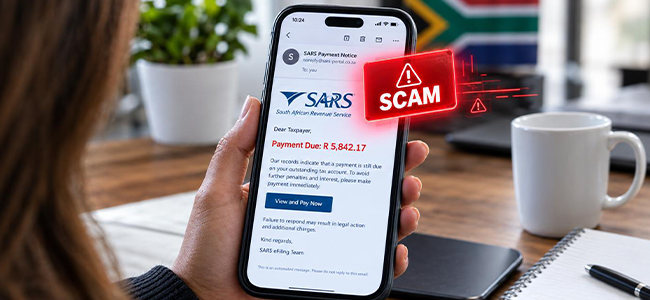
    Every day, too many taxpayers fall victim to convincing scams that use SARS’ name to steal personal information and money.

    Cybersecurity Awareness Month (every October) raises awareness about digital security, empowering South Africans to protect their personal data from digital forms of crime. It’s a good time to revisit the growing threat of SARS scams and eFiling profile hijackings.

    Common SARS scam types

    • Phishing emails: Members of the public randomly receive false ‘spoofed’ emails, made to look as if they were sent from SARS, but which are fraudulent. Examples include emails appearing to be from returns@sars.co.za or refunds@sars.co.za, indicating that taxpayers are eligible to receive tax refunds. These emails contain links to false forms and fake websites designed to look like SARS sites, with the aim of fooling taxpayers into entering personal information such as bank account details, which criminals then extract and use fraudulently.
    • Fake SMS messages: SARS does not send *.htm or *.html attachments. Any SMS claiming to be from SARS with such attachments is fraudulent.
    • Fake WhatsApp messages: SARS will not provide links to be opened or SARS bank account details for payments on a WhatsApp message.
    • eFiling profile hijacking: Criminals gain access to taxpayers’ eFiling profiles, change banking details, and divert refunds. 

    What SARS will and won’t do

    SARS will:
    ✔ Verify your personal details for telephonic engagement and authentication purposes
    ✔ Communicate through official SARS channels only
    ✔ Direct you to check your SARS profile on eFiling or the SARS MobiApp for legitimate debts
     
    SARS won’t:
    ✘ Request passwords, one-time pins (OTPs), banking PINs or eFiling login credentials through email, SMS, social media or telephone
    ✘ Request your banking details in any communication via post, email or SMS (but SARS will verify your personal details for telephonic authentication)
    ✘ Send hyperlinks to other websites, even those of banks
    ✘ Ask for your credit card details
    ✘ Send *.htm or *.html attachments
    ✘ Provide a SARS bank account number for payments
    ✘ Ask you to click any link to access its website or services
     

    What to do if you suspect a scam 

    Do not respond to communications that you suspect to be a scam. Simply contact us and let us provide certainty.

    We will check whether the message is part of an official SARS communication campaign or if it’s a known scam message currently in circulation. If it’s a new scam, we can report it to the right authorities.

    Before you share personal information or make any payments, we can verify the communication through official SARS channels. For example, if the communication pertains to outstanding debt, we can verify this directly on SARS platforms, as any legitimate debt will reflect on your SARS profile.

    How to stay safe beyond Cybersecurity Month 

    • Do not open or respond to emails from unknown sources
    • Be suspicious if a message asks for personal information or creates urgency
    • Never share confidential details with unauthorised individuals
    • Never click on any link to access SARS’ website or SARS services or to verify an account
    • Only use secure internet platforms to access electronic services such as eFiling
    • Enable two-factor authentication on eFiling profiles
    • Use strong, unique passwords and change these regularly

    SARS scams are becoming more sophisticated, but the rules for spotting them remain unchanged. When in doubt, and before taking any action, contact us.

    Disclaimer: The information provided herein should not be used or relied on as professional advice. No liability can be accepted for any errors or omissions nor for any loss or damage arising from reliance upon any information herein. Always contact us for specific and detailed advice.

    © AccountingDotNews

  • Win the War for Talent Without Paying Enterprise-Level Salaries

    Win the War for Talent Without Paying Enterprise-Level Salaries

    “Recognise flexibility as a selling point. Generally speaking, top talent wants the option to crunch numbers at a coffee shop or stay in their slippers at home.” (Kevin Kuske)

    Every small business owner knows the feeling: a promising candidate sails through the interview process, everyone loves them … And then a bigger company swoops in with a salary offer that simply can’t be matched.

    It’s easy to assume the fight for talent is over before it starts. But compensation is only one variable in a much larger equation. In addition to cold hard cash, candidates today are looking for flexibility, growth potential, purpose, and how much their work actually matters. These are all areas where lean, close-knit companies often outperform corporate giants.

    Business advisors, HR experts, and small-business owners increasingly agree: the “war for talent” isn’t only won with bigger paychecks. It’s won by understanding what employees genuinely value and building an offer around it. Here are our 8 tips.

    1. Lead with flexibility

    Flexible work arrangements have become one of the most powerful, low-cost tools available to small employers. Staffing firm Spherion notes that many candidates weigh flexibility and growth opportunities just as heavily as salary, and that smaller companies tend to have far more room to build compelling offers around said flexibility. Data backs this up: research from the Harvard Business School found that a significant proportion of employees would accept a pay cut just to keep their remote work arrangement.

    2. Make company culture your differentiator

    Culture is a genuine competitive advantage for small teams. As staffing firm Beacon Hill notes, many professionals actually prefer working at smaller companies where they can see the direct impact of their work. Business owners who can’t win on salary may still win by offering something large employers structurally can’t: proximity to leadership, visibility, and a relaxed work-life balance. Small companies should lean into this rather than apologise for their size. Job postings, interviews, and onboarding should all reflect the authentic, non-corporate environment.

    3. Prioritise cultural fit as much as skill

    Hiring for the right personality can matter more than choosing the candidate with the most impressive CV. PureWow CEO Ryan Harwood has said he’d rather bring on someone slightly less talented who fits the culture perfectly than someone highly talented who doesn’t mesh with the team. For small businesses, where every hire has an outsized impact on daily operations, getting the right fit is doubly important.

    4. Invest in growth and development

    Career growth is one of the most persuasive, and least expensive, tools a small business has. The Small Business Association of Michigan points to LinkedIn’s Workplace Learning Report, which found that 94% of employees said they would stay at a company longer if it invested in their career development. Mentorship, cross-training, and covering the cost of a certification or course all send the same message: this company is invested in where you’re headed, not just what you can do for it today.

    5. Recognise and reward often, informally and formally

    Recognition costs a little and matters a lot. The Small Business Association of Michigan also recommends building in low- or no-cost perks. A relaxed dress code, team activities, a pet-friendly workplace, alongside regular recognition programs and small rewards to boost morale are all great ideas. Because small teams are more visible to leadership day-to-day, recognition can be personal and immediate rather than buried in an annual review cycle. A spontaneous gesture from the boss is often more meaningful to employees than the corporate version of the same action.

    6. Move fast and communicate clearly during hiring

    Large companies are often slowed down by layers of approval. Small businesses can turn speed into a selling point. Business.com points out that while a small business likely can’t offer the highest salaries in its market, it can offer the fastest hiring process. On top of speed, simple communication matters. Saïd Eastman, of JobsInTheUS.com, highlights how something as small as an automatic application confirmation, or a real phone number candidates can call with questions, signals respect for applicants’ time, and sets a small business apart.

    7. Build the whole compensation picture, not just the base salary

    Salary is only one line item in total compensation. HireHive’s guidance for small employers stresses looking at the entire compensation package, including health insurance, retirement contributions, flexible time off, and remote-work stipends. This can meaningfully close the gap between a small business’s offer and a larger competitor’s, without requiring the same payroll spend. That’s not to say salary isn’t important: the number you offer has to be realistic, of course.

    8. Treat staffing as flexible, not fixed

    Not every role needs to be a full-time hire on day one. Robert Half’s research into small-business staffing points back to management theorist Charles Handy’s “shamrock organization” model, blending core full-time staff with contractors and outsourced specialists, as a way to access skilled talent without committing to enterprise-level headcount costs. This approach lets small businesses bring in specialised expertise for a project or busy season, then scale back down, all while keeping the core team lean and well cared for.

    Disclaimer: The information provided herein should not be used or relied on as professional advice. No liability can be accepted for any errors or omissions nor for any loss or damage arising from reliance upon any information herein. Always contact us for specific and detailed advice.

    © AccountingDotNews