Category: Tax

  • Non-Compliant Trust? Penalties are Piling up…

    Non-Compliant Trust? Penalties are Piling up…

    “Trustees are reminded that compliance is mandatory, and non-compliance can result in fines and penalties.” (SARS)

    SARS has significantly increased its scrutiny of trust administration. What’s more, from the beginning of May 2026, automated administrative penalties apply to all non-compliant trusts – without exception.

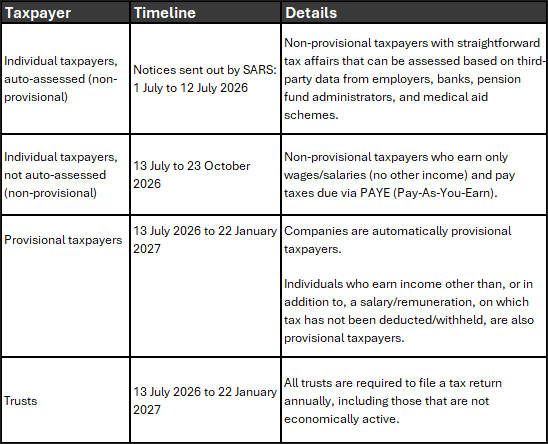
    Whether a trust is active or dormant, the trustees have a legal obligation to comply with SARS requirements, and the consequences of failing to do so are now immediate and ongoing. 

    What does trust compliance entail?

    All trusts must:

    • File a tax return (ITR12T) annually, whether economically active or not. 
    • Update and maintain trust information reflected on the SARS system.
    • Maintain a detailed organogram and records of the founder, trustees, donors, and beneficiaries.
    • Maintain strict records of financial statements, trust deeds, and minutes of trustee meetings.
    • Submit IT3(t) returns reporting detailed information on distributions and amounts vested in beneficiaries, enabling SARS to cross-reference data with beneficiaries’ personal tax returns. 
    • Some trusts may also be subject to provisional tax requirements.
    Who is responsible?

    Trustees act as representative taxpayers of a trust in terms of the Income Tax Act and personally bear sole responsibility for ensuring full compliance.

    This includes maintaining accurate trust information, ensuring that all legal and tax obligations are met, and initiating deregistration processes for trusts that meet the applicable criteria.

    Consequences of non-compliance

    From 4 May 2026, SARS will issue a penalty assessment notice for all outstanding trust income tax returns for tax periods from 2024 onwards.

    Designed to encourage compliance, these penalties are applied consistently, recurring monthly until non-compliance is corrected. Monthly administrative penalties may range from R250 to R16,000 per outstanding return, depending on the trust’s taxable income for the preceding year and will accumulate until the non-compliance is corrected, up to a maximum of 35 months.

    It doesn’t stop there. SARS may in specific circumstances hold trustees personally liable for the trust’s tax debts, and trustees are individually and jointly liable for the trust’s tax compliance.

    In addition, non-compliance with SARS obligations may be regarded as a criminal offence and will attract penalties and interest. Trustees who fail to act face penalties, interest, and potential criminal charges.

    What if my trust is no longer in use? 

    SARS requires all registered resident trusts, without exception (and certain qualifying non-resident trusts), to meet the range of ongoing obligations.

    A trust’s tax compliance obligations only come to an end once it has been formally deregistered with SARS. Until this process is finalised, the trust remains active for tax purposes and is exposed to penalties for continued non-compliance.

    Where a trust is no longer being used for its intended purpose, trustees are encouraged to formally terminate the trust. The first step is to regularise the trust’s tax affairs by submitting all outstanding returns, settling all tax liabilities, and updating all trust information.

    Thereafter the trust can be formally terminated through the Office of the Master of the High Court. Once the Master has issued written confirmation of termination, trustees can ask SARS to deregister the trust for income tax purposes.

    Count on our expertise

    If you have a trust, active or not, and are uncertain about its compliance status, contact us for expert advice and professional assistance.

    Disclaimer: The information provided herein should not be used or relied on as professional advice. No liability can be accepted for any errors or omissions nor for any loss or damage arising from reliance upon any information herein. Always contact us for specific and detailed advice.

    © AccountingDotNews

  • Selling Your Business to Retire? Get This Tax Relief!

    Selling Your Business to Retire? Get This Tax Relief!

    “A small business is an amazing way to serve and leave an impact on the world you live in.” (Nicole Snow)

    Small business owners looking to sell their business or interest in a business as part of their retirement planning will be glad to know that meaningful tax relief has been provided for them in the 2026 National Budget.

    Among other measures to support businesses, National Treasury raised the capital gains tax exemption for the sale of a small business for older persons (55+) from R1.8 million to R2.7 million, a long-overdue adjustment for inflation and rising asset values.

    The higher exemption also applies to more businesses than it did before. Where small businesses used to be defined as those valued at R10 million or less, the limit has been increased to R15 million.

    Do I qualify?

    First check if you meet the bare minimum requirements:

    • The exemption applies to individuals aged 55 or older.
    • The exemption applies when disposing of a small business with a market value not exceeding R15 million.
    • The market value of all assets, regardless of their nature, must be considered in determining whether the R15 million threshold is exceeded or not.
    • Liabilities of the business are ignored for this determination.
    • For partnerships or companies, the R15 million threshold applies to the total assets of the business, not each partner or shareholder’s fractional interest. This means a two-partner business with R20 million in assets will not qualify, even if each partner’s share is only R10 million.
    • The lifetime CGT exemption is capped at R2.7 million in total across all disposals.
    • Each asset must have been held continuously for at least 5 years prior to disposal and the individual that qualifies for the relief had been substantially involved in the operations of the business of that small business during this period.
    • The relief must be determined on an asset-by-asset basis.

    Given the complexity of this determination and SARS’ requirement that relief must be determined on an asset-by-asset basis, professional tax assistance is highly recommended.

    How could it benefit you?

    Many small business owners rely on the eventual sale of their business as their primary retirement asset.

    This tax relief can support succession planning, intergenerational transfers, and smart business exits, particularly for family-owned businesses. It encourages the sale of businesses, effectively unlocking capital and allowing for business continuity or reinvestment into the economy. 

    Of course, the additional tax-free capital gain will also meaningfully boost your retirement security after years of building a business.

    If you’re considering retiring or selling soon, it’s worth reviewing your timing with a tax advisor. We can assist you in reviewing your business valuation, assessing your CGT exposure and structure and timing your exit correctly to make the most of this meaningful tax exemption.

    Disclaimer: The information provided herein should not be used or relied on as professional advice. No liability can be accepted for any errors or omissions nor for any loss or damage arising from reliance upon any information herein. Always contact us for specific and detailed advice.

    © AccountingDotNews
  • Annual Employer Tax Recon Due End May  

    Annual Employer Tax Recon Due End May  

    “Only accountants can save the world — through peace, goodwill, and reconciliations.” (Unknown)

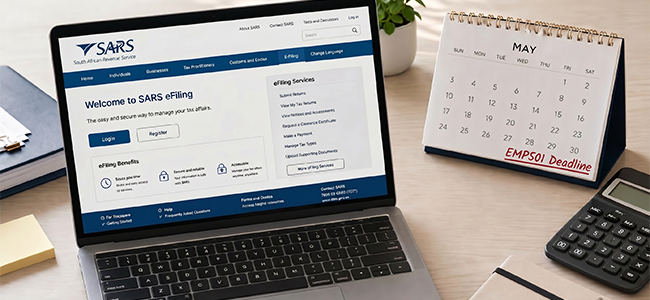
    Employers are legally required to submit their EMP501 reconciliation with accurate and up-to-date payroll and tax information (including valid Income Tax Reference Numbers) for their employees during the Employer Annual Declaration season that runs from 1 April to end May 2026.

    This involves submitting an accurate Employer Reconciliation Declaration (EMP501), issuing Employee Tax Certificates [IRP5/IT3(a)s] and, if applicable, a Tax Certificate Cancellation Declaration (EMP601).

    The submission must further balance across the three elements: monthly EMP201 returns for the period, the payments made to SARS, and the employees’ IRP5/IT3(a)s generated. As such, it provides an important opportunity to correct any errors that may have occurred during the year.

    Preparing and submitting a correct and complete declaration on time can be technically challenging, especially for larger employers. But you neglect it at your peril, as it is a focus area for SARS and the consequences of non-compliance are many.

    SARS focus area

    The Annual Employer Reconciliation Declarations is a focus area for SARS, as it not only ensures employer compliance, but also enables SARS to issue individual taxpayers with pre-populated Income Tax Returns (ITR12) and income tax auto-assessments.

    For this reason, employers can expect ongoing and increased scrutiny from SARS in this regard.

    Technical challenges

    Submitting a declaration that is correct, complete and on time (before end May) has always been technically challenging. But it just got even harder, as SARS has now upgraded missing or incorrect mandatory Income Tax Reference Numbers from a warning-level defect into a hard-stop submission defect when completing a declaration.

    This means that employee details must be verified before submission and employees without tax numbers must be registered with SARS before the company EMP501 can be submitted. Missing or invalid employee tax numbers result in incomplete submissions that will prevent IRP5 certificates from being captured, causing delays and non‑compliance for the company and all employees.

    Because so many employers struggle with technical challenges like these, SARS is rolling out technical clinics this year to make compliance easier. Or you could just let us handle it for you.

    Consequences of non-compliance

    Submitting incorrect or incomplete details, or submitting after the deadline, can result in:

    • Additional admin, time and cost
    • Employer penalties
    • Delays in obtaining an employer’s tax compliance status
    • Unexpected tax outcomes for employees

    In addition, if the EMP501 submitted is audited by SARS and PAYE liability is amended, the employer is required to re-submit the EMP501 as per the audit result.

    Expert assistance is at hand

    As the deadline looms, employers can be assured of technical challenges, increased SARS scrutiny, and even more tax-related admin and cost. All very good reasons to rely on our tax expertise and experience to ensure you submit correctly and on time.

    Disclaimer: The information provided herein should not be used or relied on as professional advice. No liability can be accepted for any errors or omissions nor for any loss or damage arising from reliance upon any information herein. Always contact us for specific and detailed advice.

    © AccountingDotNews
  • When Growth Is a Tax Problem

    When Growth Is a Tax Problem

    “As your profitability grows, your taxes will too. In fact, paying more taxes is an indicator that your business health is improving.” (Mike Michalowicz)

    Business owners work hard to grow revenue and increase profit. What often receives less attention is how that growth alters your tax obligations. Higher turnover can trigger VAT registration. Rising profit increases provisional tax exposure. Hiring staff adds payroll compliance risk. Expansion across borders introduces new tax jurisdictions. Even improved margins can create cash flow pressure when tax payments are due before debtors settle their accounts.

    Crossing the VAT threshold

    In South Africa, once your taxable supplies exceed the compulsory registration threshold (recently increased from R1 million per year to R2.3 million per year), you must register for VAT. Many businesses grow quickly and miss the moment they cross it. This simple mistake can trigger penalties, interest, and backdated VAT.

    Cash flow can become a second issue. You collect VAT on sales, but input VAT claims lag if suppliers don’t issue proper invoices. If you price incorrectly, you may end up funding VAT from your own margin. You might even have to pay output VAT on sales before you have received payment from your debtors.

    Growth often means higher transaction volume as well. That increases the risk of errors in VAT coding, zero-rated supplies, and mixed-use expenses. It’s easy to see how a small bookkeeping mistake can easily become a material tax exposure.

    Of course, there can also be benefits to registering for VAT, not least the potential right to claim input VAT on certain assets that have been purchased before you registered for VAT, and that are now used to make taxable supplies. VAT must however have been charged at the time of purchase. This can provide a nice inflow of cash, if handled correctly. Bottom line: speak to your accountant!

    Provisional tax shocks

    When profit rises, so does income tax. Owners often draw more cash as profits rise. They forget that tax on those profits has not yet been paid, and by the time the assessment arrives, the money is gone.

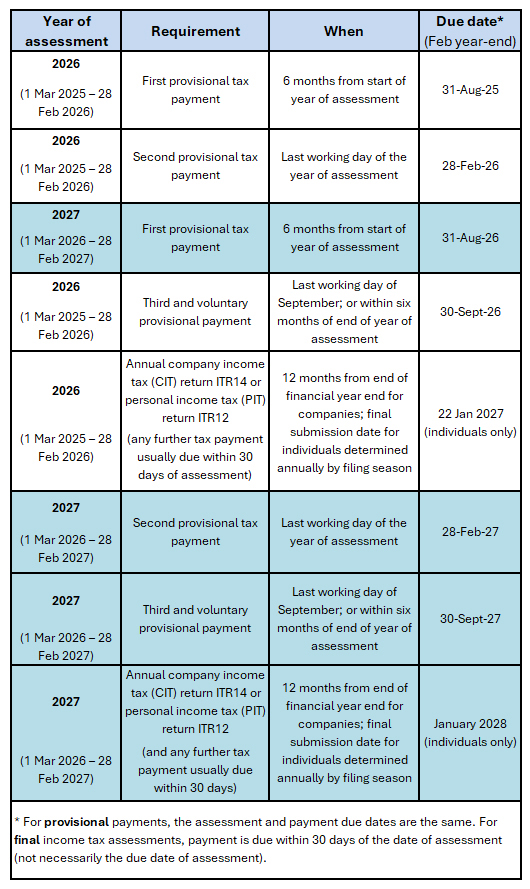
    Provisional tax can be particularly problematic. Estimates based on last year’s lower profits lead to underpayment penalties when actual results are filed. Rapid growth can produce a large balancing payment in the second provisional period, or at year end.

    Payroll expansion and compliance risk

    Hiring staff is a sign of progress. It also triggers pay-as-you-earn (PAYE), unemployment insurance fund (UIF), and skills development levy (SDL) obligations. Errors in payroll setup multiply as your headcount increases. If payroll software isn’t configured correctly, you can under-deduct PAYE. Add penalties and interest, and growth in staff numbers can become a financial setback.

    Share incentive schemes and other fringe benefits introduce potential tax complications. Without guidance, these benefits can be structured in ways that create unexpected tax costs for both employer and employee.

    Operating across borders

    Sometimes growth means selling beyond South Africa’s borders. Cross-border trade brings customs duties, foreign VAT, transfer pricing, and double taxation agreements into play.

    A small e-commerce business that starts shipping internationally may create a permanent establishment in another jurisdiction without even realising it. That can expose them to foreign corporate tax. Currency gains and losses add volatility. If not monitored carefully, taxable income can rise even when cash flow does not.

    Structural strains

    The structure that worked at start-up may not suit a larger business. A sole proprietorship with modest turnover may be efficient. The same structure with higher profit can push you into a steeper marginal tax bracket.

    When investors buy into new structures, share issues and valuations may raise capital gains tax and income tax questions if roll-over relief is not available. Growth may also expose structural weaknesses. Dividends tax and loans between shareholders and companies can create further tax considerations.

    Capital expenditure and allowances

    Expanding operations usually requires additional equipment, vehicles, or property. Tax deductions for capital assets now need to be considered. Meanwhile, disposal of older equipment may trigger recoupments or capital gains taxes. A growing business that upgrades assets frequently should definitely model the tax impact of these upgrades before committing.

    Cash flow versus profit

    Rapid growth often ties cash up in stock and debtors. Profit on paper doesn’t mean cash in the bank. Tax is calculated on taxable income, not on what clients have paid. What this all means is that a business can show strong profit, and owe tax on that profit, but still struggle to pay tax because of cash flow issues. Cash flow forecasting must include tax forecasting.

    Audit risk

    As turnover grows, so does visibility. Larger payrolls, higher VAT submissions, and bigger provisional payments attract scrutiny. Inaccurate returns that went unnoticed at a small scale can become costly when the numbers are larger.

    Internal controls that were informal at start-up stage now need formal processes. Documentation matters. Contracts, invoices, and board resolutions must support your tax position. Without them, assessments become difficult to dispute.

    Planning for growth, not reacting to it

    Growth doesn’t create tax problems on its own. Lack of planning does.

    Review your tax registrations before revenue spikes, update provisional tax estimates during the year, and align owner withdrawals with after-tax profit, not turnover. It’s also important that you reassess your entity structure as profit bands change, and model the tax impact of hiring, investing, or expanding offshore before you act.

    Growth is a good problem to have. But it is still a problem if ignored. Engage your accountant early in the growth phase, not after the assessment arrives.

    Disclaimer: The information provided herein should not be used or relied on as professional advice. No liability can be accepted for any errors or omissions nor for any loss or damage arising from reliance upon any information herein. Always contact us for specific and detailed advice.

    © AccountingDotNews

  • New VAT Thresholds: Thinking of Deregistering?

    New VAT Thresholds: Thinking of Deregistering?

    “Renette Oosthuizen, small business owner from Gauteng, had this tip: ‘Minister Godongwana, please increase the VAT registration threshold for small businesses to R2 million. The R1 million threshold has not kept pace with the cost of doing business.’” (Budget Speech 2026)

    Some of the best news in the 2026 Budget is the proposed increases in the compulsory VAT registration threshold from R1 million to R2.3 million and in the voluntary registration threshold from R50,000 to R120,000, with effect from 1 April 2026.

    This will immediately ease the disproportionate administrative burden and compliance cost on small businesses which would have had to register soon. What’s more, VAT registered businesses may apply to deregister for VAT if they no longer exceed the increased compulsory registration threshold on 1 April 2026.

    Deregistering for VAT can improve cash flow. But it’s a decision that should not be taken without consulting us, as it can trigger substantial adverse tax consequences that might well convince you not to deregister.

    Reduced admin and costs

    The compulsory registration threshold had not been adjusted for inflation since 2009. The new R2.3 million threshold, which slightly outstrips inflation, will ease the previously disproportionate compliance burden relative to turnover on smaller businesses. It may also spur unrestrained growth among many small businesses which felt forced to contain themselves to avoid the VAT net and its never-ending impact on admin and cashflow.

    Option to deregister

    Given the above, many small businesses will be keen to deregister for VAT. The good news is that it is possible for VAT registration to be cancelled – provided certain requirements are met. The first is that all outstanding liabilities and obligations in terms of the VAT Act have been resolved or settled. 

    The Commissioner will issue a notice of cancellation of registration which will also inform the vendor of the date on which the cancellation takes effect and the final VAT period.

    SARS says output VAT on certain assets on hand at the time must also be declared together with any other output tax and input tax in the VAT return for that final tax period.  In other words, you must declare the amount of output VAT on the value of the business’ assets at the date of deregistration and pay this over to SARS.

    There is also a general unpaid-creditor claw-back provision that requires a vendor to reverse previously claimed input VAT by accounting for output VAT on amounts due to creditors but not paid within 12 months of the date they became payable. This rule applies throughout the VAT registration period but is also triggered immediately before a vendor ceases to be registered. 

    Commonly referred to as “exit VAT”, this can cause immediate and possibly substantial financial implications that could strain your cashflow. 

    Before deregistering

    If you are interested in deregistering for VAT, we urge you to speak to us to ensure you fully understand the financial implications and can carefully plan the timing to avoid tax surprises and cash flow problems.

    Disclaimer: The information provided herein should not be used or relied on as professional advice. No liability can be accepted for any errors or omissions nor for any loss or damage arising from reliance upon any information herein. Always contact us for specific and detailed advice.

    © AccountingDotNews